
The project
Why FLOAT
1Keeping the thread, from the raw frames to the final image
FLOAT began with one wish: to stop losing the thread between the raw frames and the final image.
The usual way is a succession of operations on files: stack, remove the gradient, apply a filter. Six months later, nobody can say what was done. Ctrl+Z, a history stack at best. There are scripts, true. But a script cannot be tuned while looking at the image, and it is often only a starting point before carrying on by hand.
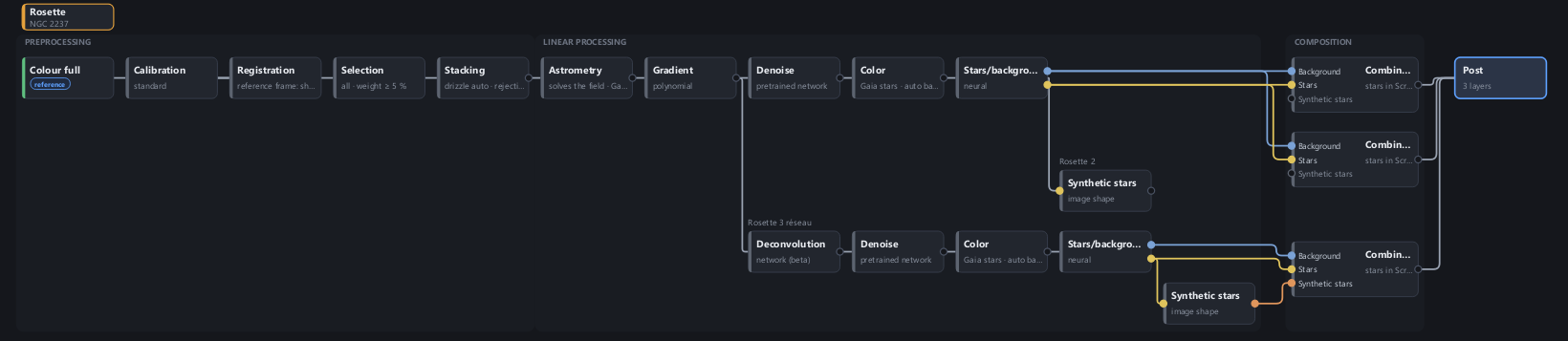
In FLOAT, the processing is a graph of blocks. It stays open: change a setting in the middle, and only what follows is computed again. Draw a branch to try something else, and both results stay side by side.
2All the way to retouching
The principle extends to aesthetic post-processing. Layers, masks, curves: each adjustment is a filter that can be switched off, changed or removed on its own, at any time. Nothing is written into the image before export.
3One coherent suite, usable by others
FLOAT also comes from a second wish: to gather, in an organised way, the programs and pieces of code we have been developing for years for our own images into one coherent suite that others can use.
- GPL v3 licence. The code can be used, read, modified and redistributed.
- Open weights. The networks used for denoising, deconvolution and star separation ship with the program, and the code that trained them is in the repository.
- No closed-source dependency. Every library FLOAT is built on is open source.
4Published methods
Every method is a published one, cited in the interface next to its settings, and every automatic value comes with the reason it was chosen. Each block’s page gives the method, its source and its limits: for instance stacking.